What does the Bible say about grief?
I write a quarterly cavalcade for Preach mag, in which I explore a pregnant word or phrase in the Bible and the ideas that it expresses. I accept written for them on:
- the phrase 'Give-and-take of God'
- the theme of 'Mission'
- the meaning of 'Apocalypse'
- the ministry building of 'Healing',
- the question of 'Welcome',
- the biblical agreement of 'Justice',
- and on what the Bible means by the term 'church'.
Here I look at what the Bible says about grief and grieving.
Information technology sometimes seems equally though our earth is full of grief. In the last year we have mourned the premature loss of loved ones, the pain of their departing made more acute by the loss of contact equally they approached their end. Nosotros are used to keeping grief at arm's length, but it has now visited u.s. shut as it has done to most of humanity for nearly of history.
Grief in Scripture
The story of Scripture is full of grief, in every part save two (to which we will render)—but it is often expressed in ways that are strikingly unlike from our own experience.
There is a beautiful cameo of grief in Gen 21. Sarah had told Abraham to have sex with Hagar her slave, since she is arid, and she gives birth to Ishmael. But when Sarah then bears Isaac, she fears Ishmael will exist a rival to him, so insists Hagar is driven away with her son to die. When they run out of water in the desert rut, Hagar
…went and sat downwardly opposite him a skilful mode off, about the distance of a bowshot, for she said, "Let me non look on the decease of the kid." And every bit she sat opposite him, she lifted up her voice and wept. (Gen 21.xvi)
The despair we recognise, every bit we do her turning abroad; so frequently the hurting of grief and death is also much to contemplate, and we turn abroad from our own pain and that of others, making grief a lonely experience of isolation.
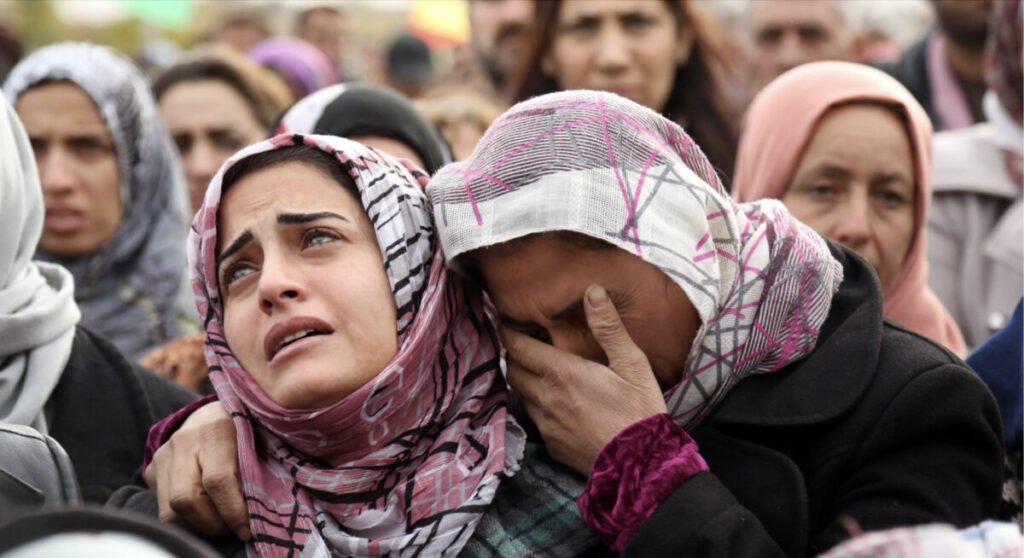
But hither we encounter a difference as well; where we often plow in and keep silent, she turns out and weeps aloud—and God hears her cry. Throughout Scripture, grief is expressed loudly, in a way we still see on our newsfeeds in the ululating women of other countries.
Concrete and communal grief
So if you want to find the grief in Scripture, yous actually have to search for the word 'weep', which occurs more than 230 times; the river of tears runs from beginning to finish. 2 striking examples are plant at the deaths of Aaron and Moses, who take non just led the people of Israel from liberty to the Promised Land, but have been their foundation equally the first Priest and Prophet for the people.
The grieving for each is expressed in similar terms:
And the people of Israel wept for Moses in the plains of Moab thirty days. So the days of weeping and mourning for Moses were ended (Deut 34.8, cf Num 20.29).
Where we often grieve inwardly, silently, and alone, here the people grieve outwardly, loudly, and together. And at that place is a clear, ritual structure to their grief, which on both occasions lasts '30 days'. Grief is a process, and takes time to laissez passer; remembering anniversaries of loss, particularly the 2d year, is a vital affair to do together.
When John Donne reminds us that 'no man is an island' and the bell that tolls for others 'tolls for thee', he is reflecting this corporate biblical perspective.
The Grief of God
Only the most surprising affair nearly grief in Scripture is that God experiences it. He hears and responds to the cry of his people; 'precious in his sight is the expiry of his holy ones' (Ps 116.15). Every bit a wife grieving at the departure of her married man for state of war collected her tears in a bottle, and so God remembers u.s.a. in our loss and grief (Ps 56.8).
The convergence of human being grief and the grief of God is found most clearly in the person of Jesus. Both his birth (Matt 2.xviii) and his expiry (Luke 23.28) were marked by weeping, and there was much weeping in between. He is grieved and angry at the sickness of a leper (Mark 1.41); he is grieved at the hard hearts of his opponents (Marker 3.5); he is deeply moved at the tears of a grieving widow (Luke seven.13); and in the shortest and most poignant verse in the whole of Scripture, Jesus weeps at the expiry of his dear friend Lazarus (John 11.35).
No wonder the writers of the New Testament saw in Jesus the servant of Isaiah 53, a 'human being of sorrows, acquainted with grief'.
Yet there was no grief in cosmos in the garden, until there was sin—and there will be none in the garden-city of the New Jerusalem.
God himself volition be with them and exist their God. He will wipe every tear from their eyes. There volition be no more death or mourning or crying or pain (Rev 21.iii–4)
How so? Because Jesus was non only a human being of grief; he 'bore our grief and carried our sorrows' to the cross and dealt with them in that location forever. He did non only taste death; he swallowed it up in victory. Though nosotros now walk through a vale of tears, one solar day that victory will be ours as well.

If you enjoyed this, do share it on social media (Facebook or Twitter) using the buttons on the left. Follow me on Twitter @psephizo. Like my page on Facebook.
Much of my work is done on a freelance footing. If y'all have valued this post, yous can make a single or repeat donation through PayPal:
Comments policy: Practiced comments that engage with the content of the post, and share in respectful argue, can add real value. Seek showtime to understand, then to be understood. Make the most charitable construal of the views of others and seek to learn from their perspectives. Don't view debate equally a conflict to win; address the argument rather than tackling the person.
Source: https://www.psephizo.com/biblical-studies/what-does-the-bible-say-about-grief/
0 Response to "What does the Bible say about grief?"
Enregistrer un commentaire